Biography

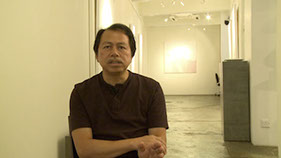
Jiwye To started his art pursuit in the late of 1970’s. In 1975 he concentrated on making attempts to rejuvenate Chinese Traditional Landscape by using the technique of spray paint. After that, he found that in Hong Kong Landscape drawing can only be succeeded by re-patterning of ancient pieces by enlarging or reducing some of the pieces as we really have no magnificent local scenery for inspiring our works.

To him, as tradition and modern steps have never originated in Hong Kong, the local atmosphere is somehow disadvantageous for the learners who can hardly find anything to depend on. The same feeling of loss was presented by a project of To works on 1976, naming “Cloud: In and Out”. The learners will find their ways clearer in clam and fine day. While facing a cloudy and windy sky, learners will easily be left at a loss.

After that project, To saw that starting from the Vernacular Literature Movement, the Chinese artist sometimes rush to the avant-garde art but something engage on a retreat going back to the tradition. Perhaps this show that the choice between tradition and modern influence is still an irritating problem for our artists and many of the artists rely upon finding a place temporary rest and practices. This is what To hopes to convey through another two projects, “Where is my Home” and “A World of Clouds with an Endless Sea” at the very beginning of 1977. The latter project suspect the contribution and influences of the notable Overseas Chinese artists to Chinese modern art and also it is a chance for the foreign critics to measure the suitability and many other aspects of the Chinese art.

From 1977 to 79, Jiwye To studied art in Grantham College of Education. During the study, he was the crossroad of East and West culture so he considered the problem of culture identification. He read many books and researched different category of art and literature specially the theory of Chinese and Western art, Taiwan modern art and literature, Chinese traditional painting and calligraphy. After the study, he began to understand himself and his identity. He was sure he is a man from the East, living in the East. As a result, he decided to put all his effort in working for the East.

In 1982 To melted Chinese metaphysical ideals, the technique of Chinese traditional painting, the mood of modern man, the elements of Western art into one pot in his “An Association of Lotus” installation in order to express the emotion and psychological state of modern Chinese. Meditation which combine with thirty-two mirrors and a Buddhist image was the representative work. The mirrors reflect the spectators so that the spectators are part of the artwork.

From 1986 to 89, To studied art and philosophy in Hong Kong Buddhist College. Over the years, after constant study and research, a distinct direction and cultural concept – develop his art by starting from the integrity of Chinese culture – has gradually appears in To’s mind and work. The idea of Zen and Phenomenology become his view on life and nature and elements of his art.

From 1984 to 1988, he published the arts criticism magazine “Melting Pot Journal” to promote art criticism in Hong Kong. The magazine had commented the development of art in mainland China, Hong Kong and Taiwan. He acted as the editor and developed the magazine into interactive media amongst Chinese artists all over the world.

In 1988, he participated the China contemporary art movement and promoting the concept of “Art China”, with a view to forging open a new way to develop Chinese contemporary art.

In 1989 he founded an art group called the Art Action which teamed up with artists from mainland China, Taiwan, Hong Kong and the USA to promote Chinese contemporary art and the idea of “Art China” with exhibitions, lectures, seminars and forums in different parts of the world.

In 1995, he organized a conference in Hong Kong to discuss the idea of “Art China” and the development of Chinese contemporary art in the 21st century. Scholars of mainland China, Hong Kong, Taiwan, Australia and Canada were invited to address the issue in the conference.

To has participated in numerous local and overseas exhibition in museum, gallery and art fairs. His works are being collected by private collectors, corporations, and museums: Shanghai Art Museum, Hong Kong Alliance of Francaise, Macau Urban Council Gallery, The University of Sydney, The University of British Columbia, Canada, The Chinese Cultural Center of Vancouver.

Introduction

The Association of Lotus

The “Lotus” of Jiwye To is his personal search for art and a place where he can dream. His “ Lotus” reveals his outlook on life. There are a lot of legends about lotus in the East. Jiwye has been searching for the essence of the East and the West. In these years, he has turn his attention to the East and has decided that he should be his own direction – a man of the East should put all his strength to search for the East, study the East and develop the East in order to work for the future of East.

At the turning point, Chinese culture came to his mind. He is aware that a youth of his nation should show the qualities of a patriot. However, the home country is such that he can do nothing for it. Thought tradition belongs to the past, we cannot ignore it. It is because tradition is always one after the other. The East artists of Yang Zhou were once the avant-grade artists. Today these eight artists have became the tradition, so the avant-grade of today will become tomorrow’s tradition.

Things are changing all the time. However, there is the same law. Yesterday, today and tomorrow will all pass away. When one is facing such a circumstance, everything is actually a fancy. It is from this fancy that one can find oneself.

“The Association of Lotus” is figurative, abstract, realistic and full of expression. Figurative work shows any material object. Abstract work shows an object that has been treated by an artist. The realistic works shows the outer part of the lotus while the expressive work shows the inner world of the artist. When things are at the best, one cannot categorize them anymore.

Wong Hor-ying
1982
Hong Kong Art Centre Monthly, April, 1982

Introduction

Meditation

Installation (Image of Buddha ,mirrors and spectators)

1984

Form

This art work is in a square arrangement with an image of Buddha in the middle of the installation. Thirty six mirrors surround the image of Buddha. The spectators are part of the art work when they stand in front of it . The art work can change the content depend on the change of the quantity and the movement of the spectators.

Implication

The work reflects the concept of Chinese philosophy – human and cosmos are as one. There is a contrast between the numerous spectators and the closing eyes Buddha. By the reflection of mirrors, spectators seem to exist with Buddha. They can experience lives by seeing themselves and the others simultaneously from the reflection of mirrors. They can think about their living deeply at the moment.

Idea

The artist provides a platform to let spectators to take part in the art work. The spectators are parts of the work. The artist uses the simple materials to create a versatile art work.

Introduction

For his first exhibition in Melbourne, Jiwye To presents a curious mix of traditional Chinese scroll painting techniques and Western abstract expressionism.
Where there is social comments, it is veiled. One work, for example, depicts mountains, meticulously painted in a recognisable Chinese style, overwhelmed by angry black slashes
To the West, it might seem an uneasy combination of irreconcilable painting style, perhaps too mannered and decorative to be effective as political comment. But then political comment is not Jiwye To’s aim. Rather, he wants to provide objects of quiet contemplation.
I suspect that, in the end, Jiwye To’s paintings simply point out the inadequacies of the sort of cultural theory that underpins so many recent exhibition about our relationship with Asia.
Peter Timms
Editor of Art Monthly Australia

Introduction

MIND IS COSMOS
JIWYE TO RECENT WORK
April 23 – May 11, 1998
QUADRIVIUM, Sydney, Australia
Thought is the basic necessity in our daily life. We cannot imagine how the world would be if one had no thought. The human being has developed in various ways in different regions therefore developed different pattern of thought. A culture must be shaped from the beginning of thinking, internal and external. We face different objects every day and we consider the relationship between objects and human beings. Is there a gap between objects and human beings? Are there any similarities in the essence between objects and human beings? How does the artist apply life on art when the source of art is life?
Human beings have been considering these problems and have different viewpoints depending on the space and time in which they live. In the West, the thought is restricted to the external substance, there is no intercommunication with the internal mind. Therefore, many thinker wants to search for a new way of extreme freedom of thought from the external substance, such as Hegel, who explored and brought up the theory of absolute Idea.
In China, the thought of Zen exceeds the external substance and phenomena. It touches the essence directly so there is no difference in essence between phenomena and human being. Phenomena is human being, human being is phenomena. There is no gap between phenomena and our mind. We can be fully free in our mind when we face any external substance. It is not only the quintessence of Chinese traditional art but also the viewpoint of life and nature of the Chinese.
This generation of Chinese live in both Chinese and Western thought. These two thoughts interact in the Chinese deeply and widely. The development of Chinese culture has been constructed through the acceptance and reflection of these two different thoughts in the 20th and 21st centuries.
As a Chinese contemporary artist, Jiwye To studied Chinese and Western philosophy and art in the Hong Kong Buddhist College in the late 80’s to research a new way in art. Over the years, after constant study and research, the thought of Zen and Phenomenology become his view on life and nature and the basic element of his art.
Jiwye To’s recent works, MIND IS COSMOS, are based upon the thought of Zen. Within these works there is essence of phenomena, the elements of essence – point, drop, jump, flow, rush, sprinkle, turn and rotate. These lead us to the essence of substance and meditate how the essence constructs phenomena. Thus Jiwye To converts the concept, technique and element of Chinese traditional art in a new way – the manifest of different types of space and another visual images that bring us to another vision in our life.

Introduction

31 MARCH TO 30 APRIL 2006 East & West Art, Melbourne, Australia The essential factor in sensing art is receiving the messages for the artist. One can gather detailed information, develop technical competence and analyze as long as the spectator receives the artist message. Our understanding of Chinese painting is the capturing of the essence of the objects and not their outward visible form which is important; it is the successful transmission of the feeling, the inner spirit or movement and not the precise depiction of the objects by which the art is measured. Michael Sullivan in his book The Meeting of Eastern and Western Art states, “Western realism, because it demands an analytic approach to the subject, gets in the way both of free calligraphic expression and the intuitive generalization from experience that give Chinese painting its timeless, universal quality…” There has been steady progress from both Eastern and Western artists this century toward the creation of a global artistic approach; one which is rooted in the respective cultures but which has its foundation the communication of higher ideals through art. An awareness which seemed to emerge most significantly in Abstract Expressionism, where the physical and philosophical methodology merged as one. The example being Jackson Pollock and his “Action Painting” and what he said about his method, “….the painting has a life of its own. I try to let it come though. It is only when I lose contact with the painting that the result is a mess” and seventeenth century master, Shitao, who in his essay on painting, “Hua yu lu”, talked of the artist’s exhilaration carrying him through the painting on an unbroken surge of power. Is this, the enlightenment of Zen? The inner spirit of traditional Chinese painting, Qi ?
Zen can be analyzed, it can be described, it can be sensed but it is a vague image with no substance until it is experienced. How do we know that it really exists? Aside from the testimony of many who seem to know, there are the paintings of the Zen masters. Contemporary Chinese painting has absorbed many stylistic and technical developments from Western art over the last century in areas relevant to their style but have never lost touch with the essentially inner spirit of great art form which their tradition springs. Drawing from Matisse …. An artist is born with the sensibility of that period, and it counts for more than any learning can give them. The artist communicates the age and anyone who cultivates their sensors can communicate with this inner spirit. You are invited to make the transition from spectator to perceiver.
Jiwye To lives in this the 21st century, this generation of Eastern and Western thought.Jiwye’s new series Cloud is Mountain incorporates his study and teaching in Buddhist art with his life in modern Hong Kong. A contrast which he defines by mountains, fixed to the earth and solid, with clouds, spirits, pure and refined. Yet he complicates this by the imagery of the fragility of both, in that the mountain can always be moved by man, whereas the cloud cannot. Though the cloud may dissipate it can always return in a different form. Jiwye’s paintings can always be analysed but the spectator will always perceive his work in their own individual way. MARJORIE HO, Gallery Director

Introduction

“Distant Void” is based upon the thought of Emptiness. The misty vision and the white space bring us see and think more and the spectator will always perceive the vision in their own individual way. I convert the concept, technique and element of Chinese traditional art in a new way – the manifest of different types of space and another visual images that bring us to another vision in our life- leisurely and carefree, peaceful and harmonious.

Introduction

“Emptiness” is not the same as “nothing there”, it is actually an extraordinary presence. This is so because the essence of phenomena is really emptiness. All phenomena and all existence arise from emptiness. If we can realize the truth of emptiness, we can transcend emptiness, empty emptiness itself, and reach absolute emptiness. At this time, everything in life can be resolved by absolute emptiness, at this point, we can face the infinite inscrutability of the universe feeling free and unconstrained. When the mind is empty, it can contain everything. All is one.

Introduction

Jiwye stresses the emptiness of Zen in his art. Zen does not talk of or pursue beauty directly. We should understand beauty and art through our own inner perception and experience, not through our direct perceptual sense. Emptiness does not mean white space on the painting but provides space for thinking and imagination for viewers to re-examine their inner world.
Jiwye uses a large number of Chinese traditional art concepts, techniques and elements but does not emphasize the linearity of Chinese traditional painting, or the use of simple materials in his art. Building up the “oneself”, then breaking down the “oneself”, thus achieving his idea of Emptiness. Emptiness is an extraordinary presence. Therefore, Jiwye abandons the shackles of the traditional, breaks away the constraint of forms and materials and conveys the understanding of Zen with a minimal form and frame. His art shows a strong visual impact, strengthening the response between the intension of art and the viewers. His art is full of contemporary sense and gives the viewers multiple spatial and visual images. The viewers can take pleasure in a sense oftranquility, accentuating the enjoyment of the emptiness and beauty at that very moment. This is the art concept and the viewpoint of life of Jiwye.
Cai Xiao

Introduction

“Autumn Floods” Strolling Zhang Pingjie Critic / Curator Senior Researcher of Film and Visual Art / REC Foundation, New York Visiting Professor of New Media Art Dep. Tongji University, Shanghai I know Jiwye for over twenty years and comprehend the development of his art. From the dark ink and powerful brush-stroke abstract paintings to the mirror installation with the idea of no boundary between object and self, it is the enlightenment of his life and thought and the evolution of his art style. Jiwye has been studying Western and Chinese philosophy, particularly the though of Zen and the “emptiness”. We can experience the emptiness in quietness and tranquillity in his recent paintings. His early ink abstract paintings express the form of emptiness and the recent vast and hazy mountain and river images show the spiritual emptiness. He has found his spiritual meet point in these images. Intangible and invisible, living in this human world, Jiwye observes everything beyond this human world. We can understand the nature of everything when we view object from the object itself. Thus we can be free of ego and release our attachments. Jiwye’s vast and hazy mountain and river image is the way of observation of individual. He creates the Autumn Floods series paintings by reading in images from Zhuangzi’s essay Autumn Floods. The still, misty and dream-like vision is the original world that Jiwye wants to pursue.
A series of uninhabited and dream-like autumn landscapes vision let the spectators away from the human world, release attachments, forget the distinctions,wander in absolute freedom, live in a unrestrained, no-action, pure thought and carefree life , attain the spiritual freedom without any bondage.
Let the mind be free is the discipline way in harmony with nature of ancient Chinese philosophies, it is usually a speculation, a meditation. In “Autumn Floods” series paintings, the spirit of this metaphysics has been refracted by image, like a bunch of divine light penetrate our hustle and bustle materialistic society. Autumn Floods , beyond the material and the desire of the society, is a gift for purification.
“Autumn Floods” is quiet with voiced. “Autumn Floods ” is empty with substantial. “Autumn Floods “ is misty with clear. “Autumn Floods” rolled by with traces, “Autumn Floods” solidify with enlightenment. “Autumn Floods” is movable with silence. Autumn river is nice.

Introduction

‘Sound of Emptiness’, this series of painting transcends the contrary of the binary system and crushes the difference between oneself and others, as well as between the subject and the object. In this paintings, Jiwye showcases plenty of blank spaces to present the concept of emptiness, depicting painting objects with their original natures and conditions.
Inspired by the sound of Spring, the theme of the ‘Sound of Emptiness’ allows its audience to indulge in a scene where stream and waterfall flow into layers of cloud which appear so vast and void. The blankness found in the paintings symbolizes both fog and cloud in a scene, thus revealing both void and real. The cloud and mist over the mountain is an actual situation of mutually referent to represent the aesthetic sense of blankness and emptiness. All together, the paintings cerate an infinite imagination to the spectators, allowing them to feel virtually free and feel like traveling through space and time, and hence forget all changes across time, space and human beings.

Introduction

This work is inspired by the poem of Su Shi (1037-1101). It is composed by eight individual pieces of paintings. From the different combinations of the eight pieces, spectators may see the different space that allow them have different sense of beauty. Cloud, mountain, river and sky are in hazy state. The scenery seems to be having something or nothing there, fully accompanied by emptiness and silence in the movement, from limited to unlimited, transcending emptiness. Dissolving into the scene, spectators are able to have multiple associations.